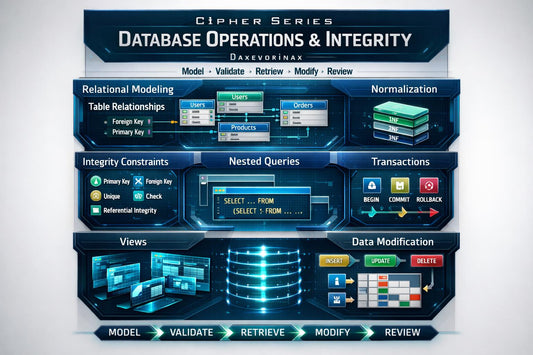
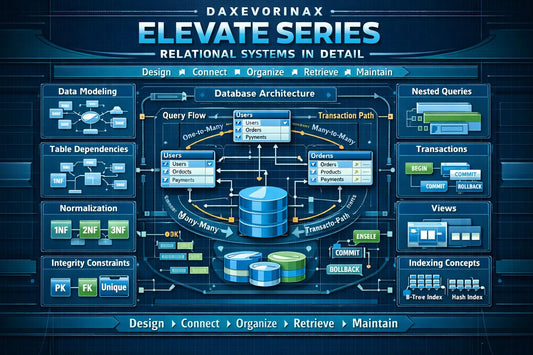
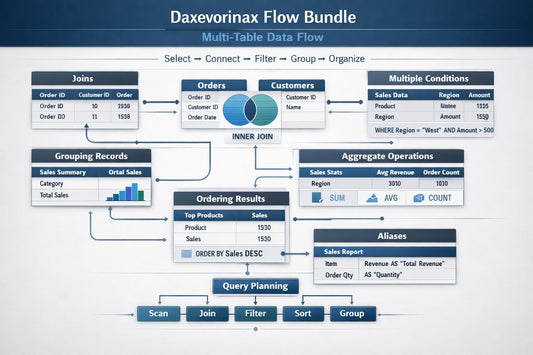
Abstract 3D digital illustration featuring teal and white geometric blocks, cylindrical spool-like forms, and thin white lines on a blue and gray background.

 Build a Clear Foundation in Database Concepts 

An infographic titled 'Daxvorinax Lattice Library' showing a 3D isometric model of interconnected database nodes with labeled concepts such as relational models, normalization, constraints, multi-table queries, nested queries, aggregate operations, and table dependencies on a dark blue background.

 Explore Courses 

Shop all

 Begin with a Free Database Guide 

Start exploring Daxevorinax with the Free Set, an introductory resource created around foundational database concepts. The materials introduce tables, rows, columns, fields, records, identifiers, relationships, and basic query concepts in a structured sequence. It provides a practical starting point for becoming familiar with database terminology and understanding how structured information is organized. Download the Free Set and work through the materials according to your own study schedule.

 30-days refund guarantee 

Try the course completely risk-free. We want you to be fully confident in your investment, so if you're not satisfied with the content for any reason, you can get a full refund. No questions asked, and no hoops to jump through. Refund requests may be submitted within 30 days of purchase in accordance with our Refund Policy.

  • A hand holding a white stylus points at a tablet screen displaying a 3D software asset pack titled 'DATABASE VERTEX KIT' on a solid white background.
  • A hand holding a white stylus points at a tablet screen displaying a 3D software asset pack titled 'DATABASE VERTEX KIT' on a solid white background.
  • A black smartphone shown upright against a plain white background, with its screen on and displaying a blue and white graphic that reads 'CIPHER SERIES'.

 Building Knowledge, One Record at a Time 

Our mission is to provide structured database education that makes complex information easier to examine step by step. Daxevorinax connects foundational concepts with practical examples, helping learners develop their knowledge of data organization, relational structures, queries, and database design at a steady pace.

  • Peter Wynn — Database Schema Analyst

    Peter Wynn 

    Database Schema Analyst

    Calder examines database schemas and studies how individual components connect. He reviews fields, relationships, constraints, and structural dependencies. His work involves documenting and evaluating relational database organization.

  • Meyor Sloane — Data Modeling Consultant

    Mayer Sloane 

    Data Modeling Consultant

    Mayer is responsible for developing data models that represent entities and their relationships. He works with attributes, identifiers, dependencies, and relational structures. His work helps translate information requirements into organized database models.

  • Tamsin Greer — Database Integrity Specialist

     Tamsin Greer 

    Database Integrity Specialist

    Tamsin focuses on consistency and integrity within relational database structures. She examines constraints, relationships, identifiers, and data organization rules. Her work centers on maintaining logically structured informatio

 From Data Curiosity to Daxevorinax 

Daxevorinax began when our team recognized that database topics were often presented as separate technical ideas without enough attention to how they connect. We started organizing our own diagrams, explanations, and practical examples around tables, records, relationships, and queries, gradually developing them into a structured collection of database learning materials.

  • A digital vector illustration of a central teal cube connected to eight surrounding blue and teal 3D block icons arranged in a circular pattern on a solid white background.

    Clear Structure 

    Topics follow a logical sequence that connects foundational database concepts with increasingly detailed relational structures.

  • A minimalist vector icon depicting a server database cylinder flanked by two teal lock keys on a white background with a soft drop shadow.

     Practical Context 

    Database concepts are supported by relevant examples that demonstrate how tables, relationships, queries, and records work together.

  • A stylized vector illustration of a multi-layered database cylinder with blue, teal, and white stripes, connected to small circular nodes on a plain white background.

     Detailed Learning 

    Each course combines explanations, diagrams, and learning activities to explore database topics from multiple perspectives.

  • An isometric digital illustration of a stacked server rack or network architecture diagram, featuring shades of blue, teal, and white on a solid white background.

    Flexible Study 

    Downloadable materials allow learners to follow the course at their own pace and revisit individual sections when needed.

 See What’s Inside the Curriculum 

Explore the Daxevorinax course collection and see how database topics are organized across different learning stages. Each course combines structured explanations, practical examples, diagrams, and learning activities covering relational database concepts. The collection progresses from foundational topics such as tables, records, and relationships toward broader areas including data modeling, queries, normalization, constraints, transactions, and database organization. Use the “Preview Courses” button to explore the available courses and compare their learning topics.

  • Maren Whitaker

    Lizzy Whitaker 

    Lizzy started with introductory knowledge of structured data and wanted to develop a clearer understanding of how relational databases are organized. She found the combination of concise explanations, visual structures, and practical examples useful when examining relationships between different database components.
    “The diagrams helped me see how tables and relationships fit together instead of viewing each concept separately.”

  • Everett Hayes

     Everett Hayes 

    Everett had previously explored database terminology independently and wanted learning materials that brought foundational and relational concepts together in one organized format. He appreciated the diagrams, step-by-step explanations, and examples showing how tables, identifiers, relationships, and queries interact.
    “I liked being able to follow the material in sequence and revisit individual sections whenever I needed more context.”

  • LinkedIn logo on a white background
  • GitHub logo with a black circle and white cat-like face design
  • Black circle with a white letter 'M' in the center

    C